.hack//ENEMY is a discontinued trading card game based on the .hack world. Originally released by Decipher, the game was proven to be a unique experience and even won the 2004 ORIGINS award for "Best New TCG." Before being discontinued, the following starter sets and booster series were released:

.hack//ENEMY card
- Kite Starter Deck
- BlackRose Starter Deck
- Terajima Ryoko Starter Deck
- Sanjuro Starter Deck
- Mia Starter Deck
- Elk Starter Deck
- Gardenia Starter Deck
- Marlo Starter Deck
- Contagion Booster Set
- Distortion Booster Set
- Epidemic Booster Set
- Isolation Booster Set
- Breakout Booster Set
- GIFT Limited Edition Premiums
- Promotional Cards
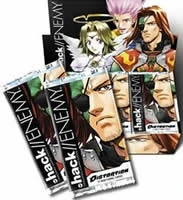

Enemy booster packs and a starter deck
Object of the Game
To successfully score 7 points by attacking the opponent with monsters.
Deck Size
60 cards, no more, no less.
The Cards
Anatomy
All combat-related cards have a strength value. They may also have an effect. All cards have a destiny number on the top-right corner. Some PC and item cards may also have spheres under their strength. This is known as tolerance, and tolerance can prevent your PC from being wounded or killed. Monsters have something called a Reward (located at the bottom of the card), which is an extra effect that may be activated if it wins a battle.
Types
- Monsters: These are the heart of the deck. Monsters are used to attack the opponent. Most monsters have a score rating of 1, meaning a successful attack from it gets you one point. Some monsters are powerful but have a score of 0. Some really rare ones have a score of 2 (or more), meaning they count as 2 (or more) points if they succeed in their attack.
- PCs: These are a player's single line of defense. You can build up a PC and use their effects in battle. It's always best to have a PC to fall back on to prevent the opponent from scoring.
- Events: These are effect cards. They are one-time effects that are discarded immediately. A player can use one only during his/her turn.
- Field: These are field cards. They stay on the field and their effects are continuous. Can be useful, can be crappy. A player can use one only during his/her turn.
- Actions: These cards must be "hidden" before activation, and are usually only used during the opponent's turn.
- Items: These are cards used to equip on PCs to make them stronger. These will greatly enhance a player's ability to survive in the game. Only one subtype of each item (weapon, armor, etc.) can be equipped on one PC.
- Grunty: These cards first appeared in the Epidemic set, and all have useful effects that can be used instead of playing a card from the hand. These effects require that a Grunty be a certain size, which is achieved by feeding it. A Grunty can be fed only when the feed condition is met. If the condition is met, a Grunty can be fed by placing a card from the hand face down under the Grunty. A Grunty's size is equal to the number of food cards placed under it, and it can reach a maximum size of 5.
The Area
- Deck: The deck is placed on the lower-right hand side of the play area.
- PCs: Up to three PCs and their equipped items are placed in the upper-lefthand corner of the play area. A player can only have one of each PC at any time (no one can have two Kite cards in play, etc.); however, the opponent may have a PC of the same name on the field.
- Hidden: Up to five cards can be "hidden" by being placed face down on middle section of the play area. Any card can be hidden, but only Action cards can be activated from the hidden position.
- Portal: Storable monsters are placed on the portal to the right of the PC area. Any number of storable monsters may be stored here.
- Field: Field cards are placed above the discard pile. Only one field card can be in play at any time.
- Score Pile: Victorious monsters with a score point are placed at the lower-lefthand side of the play area.
- Discard Pile: Not-so-lucky monsters, fallen PCs, destroyed items, used up events/actions, and destiny cards are placed in the discard pile to the right of the deck.
Gameplay
Before play, both players must reveal a random card in their deck. The player whose card has the highest destiny number goes first. If the destiny number is the same, repeat until someone has a higher destiny number.
Draw Step
At the start of a player's turn, the player draws a card. After drawing, the player must reconcile the hand by drawing or discarding cards until the player has exactly five cards. If there are no cards in the deck at a time when the player must draw, reshuffle the discard pile to make a new deck. If such an event occurs at any time during the game, play ends after the current turn is ended and the player with the most points wins (if both players have the same score, it is a draw).
Play Step
After reconciling, the player may choose to do one (and only one) of the following actions:
- Play a PC: The player can add PCs to his/her party or replace a PC with another (the previous PC is discarded). Items from the previous PC can be transferred to the new PC if the new PC can legally use them; otherwise unusable items are discarded. If a PC is wounded, the PC can be replaced by a fresh PC, even if that PC is of the same type (for instance, a wounded Natsume can be "healed" by replacing her with a fresh Natsume).
- Play a field: Any current fields are discarded if a new one is played
- Play an item: Items can only be equipped to valid PCs; some items are too heavy to be equipped by "light" and "medium" classes, and class-specific weapons can only be equipped by their respective classes (Air Rod can only be equipped by Wavemasters, etc.).
- Play an event: Do what an event card says and discard it.
- Play a hidden card: If a player can't do anything else or chooses not to do anything else, the player may choose any card in his/her hand and place it face down as a hidden card. If a player already has five hidden cards and chooses to hide another card, one hidden card must be sacrificed (discarded).
- Play a monster: A monster may be chosen to attack or stored in a portal. Only Storable monsters can be stored. Once stored, there is a requirement that must be fulfilled in order to move out of the portal and attack the opponent (for instance, most storable goblins can only attack when another goblin attacks). Any number of monsters can be stored, but monsters with a large dot before their card names are unique, and only one copy of that monster can be in play at any time (applies to opponent as well).
- Use a Grunty's effect: A Grunty's effect can only be used during this time, in effect sacrificing a play.
- Reshuffle your hand into your deck: This is an option only during the first turn. This way, the player can get a fresh hand during the next turn. (Note: This rule change is documented in the 1/11/05 Current Rulings Document.)
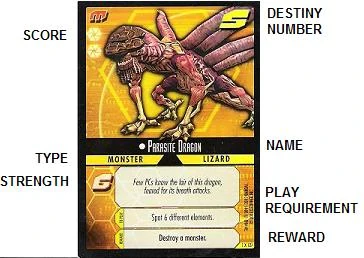

Anatomy of a monster card. Note that Parasite Dragon has a dot next to its name, meaning only one Parasite Dragon can exist on the field at any time.
Spotting
Some cards require that the player "spot" something in order to play. A card is "spottable" if it is in play. If the requirements are not in play, that card cannot be properly played. For instance, Repth requires that one Water element be spotted in order to activate. If no Water-element cards are in play, Repth cannot be used. Note that you may spot any player's cards, not just your own.
After doing one of the above actions, if a monster was chosen to attack, the player moves on to the attack step. If not, the turn ends and it is now the opponent's turn.
Battle Step
Monster cards chosen to attack the opponent are dealt with by the opponent's PCs. If the opponent does not have any PCs (or if the opponent chooses to avoid battle) then all scorable monsters are added to the attacker's score pile and their rewards are activated. When the defender chooses to avoid battle, that means that no PCs engage in battle (the defender cannot choose to avoid some enemies and battle others).
If the defending player chooses to battle, he/she gets to assign one monster to fight each of his/her PCs. Once each PC is assigned a monster to battle, if there are additional attacking monsters, the attacking player must assign those additional monsters in any manner.
A battle takes place between a defending PC and all monsters assigned to fight that PC. The PCs total strength is compared to the total monsters' total strength. At this point, actions can be used to affect battle strength (either flipped as hidden cards or revealed from hand if the PC has any speed icons). After actions have been used, both players "draw destiny" by drawing one card from their respective decks and adding the destiny number of the drawn card to their respective force's total battle strength. After drawing destiny, the total battle strength is resolved. If the PC has higher strength, the enemy force is destroyed. If the enemy force is higher or equal, the PC is wounded (or if wounded, the PC and all of its equipped items are discarded), all enemy rewards are used, and one scorable monster is chosen to go to the score pile. After a fight is resolved, play moves to the next fight, or if there are no more fights, the current turn ends.
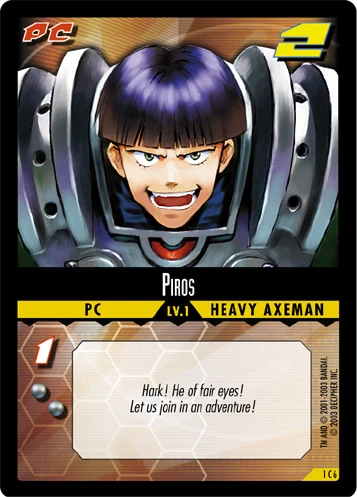

An example of a PC with +2 Tolerance
Tolerance
Some PCs or items add "tolerance" to the PC. Tolerance is shown by silver spheres under the battle strength. If a PC loses a fight, tolerance may prevent the PC from getting wounded or dying. If a PC loses by a number of points that are less than or equal to that PC's tolerance, the PC does not get wounded or destroyed. For instance, if a healthy PC's battle power is 5 +2 Tolerance, and the monsters' total battle power is 6, the PC loses the battle, but does not get wounded.
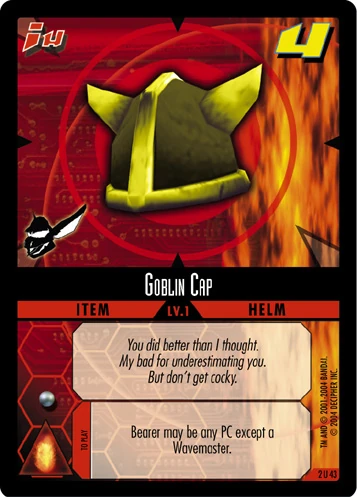

Example of goblin item (goblin icon is the goblin head)
Goblin Items
Added in Distortion, there are four items that bear a goblin icon indicating that they are goblin items. A PC equipping 2 or 3 goblin items is strength +1 and is strength +2 with all 4.
Speed
Also added in Distortion, some item cards have a speed icon that indicates that the PC equipping the item has speed. For
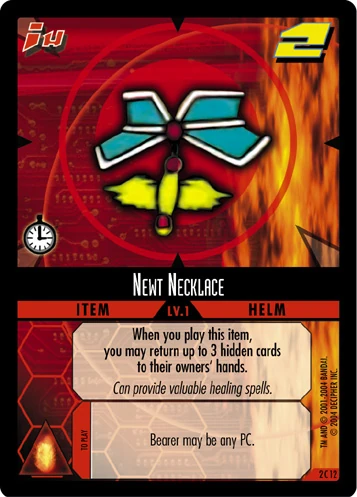

Example of item with speed (speed icon is the small clock)
each speed icon the PC has, you may flip one action card directly from your hand when that PC is in a fight, just as if the card was hidden. Quoting from the Epidemic rulebook:
For example, your Subaru bears a Newt Necklace helm and Snow Panther boots. When she is in a fight, you may flip a Gan Basher action card and a Rue Tornado action card from your hand.
Play cycles between these three phases until a winner is decided.